
What Goes Into a Professional Corporate Interview Setup
When we arrive on location for a corporate interview — whether it's a conference, an office, or a rented event space — the first thing we do before touching the camera is assess the room. Where's the light coming from? What's on the walls? What are the problem areas? The answers to those questions determine everything that follows.
Most spaces have at least one feature that looks appealing at first glance and turns out to be a liability. Windows are the classic example. Natural light through a window can look beautiful, but it changes throughout the day — and consistency matters when you're filming multiple interviews across several hours. A frame that looks right at 9am can be completely blown out by noon. We've learned to prioritize controllability over beauty, especially on longer production days.
Building the setup
Once we've chosen a location in the room, we cut the overhead lights. Fluorescent and LED overheads create mixed color temperatures that make skin tones difficult to correct in post. Getting that out of the equation first gives us a clean starting point.
From there we build the lighting from scratch. Our standard corporate interview setup uses three sources: a key light, a fill light, and a background light.
The key light is the primary source — a softbox-diffused light positioned to one side of the subject's face. Soft, diffused light wraps around the face and minimizes harsh shadows. A honeycomb grid on the softbox helps control spill, keeping the light focused on the subject rather than bouncing off the walls and back into the frame.
The fill light is small and subtle — just enough to reduce the contrast on the shadow side of the face. Whether to use one at all, and how much output to dial in, depends on the look we're going for. More contrast reads as dramatic. Less contrast is cleaner and more neutral — usually the right call for corporate and nonprofit work.
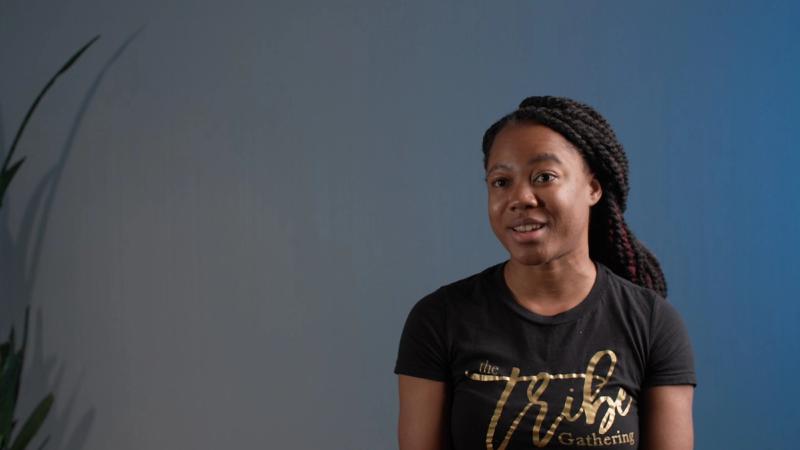
The background light adds dimension. A flat wall behind a subject makes for a flat, uninteresting frame. A small RGB light angled at the background wall introduces color and a subtle gradient that gives the image depth without calling attention to itself. The key is restraint — it should add interest, not dominate.
Audio
Lighting gets most of the attention in conversations about interview quality, but audio is just as important — and more likely to be the thing that makes a video feel unprofessional if it's handled carelessly. We boom a directional microphone as close to the subject as possible, just outside the frame. Proximity is everything: the closer the microphone, the less room noise gets recorded alongside the voice.
Why this matters for the finished product
A well-lit, well-recorded interview gives the editor options. Clean audio cuts cleanly. A subject lit with intentionality looks polished and credible on screen. When a video is built around testimonials or executive interviews — which is true of most corporate and nonprofit video work — the interview footage is often the most important material in the piece. Everything else supports it.
We've set up corporate interview rigs in conference rooms, hotel ballrooms, office lobbies, and event spaces across the country. The room changes every time. The approach doesn't.
If you're planning a project that involves on-camera interviews and want to talk through what professional production looks like, we'd love to hear about it.